
Reading Aloud at the End of Life: True Engagement in Life Review
 Submitted by Laurette Klier, M.ED., CDP, CSA, iCST
Laurette Klier is the founder of NostalgiaWorks (NANA’S BOOKS) and co-founder of Mindful Libraries. She creates identity-affirming reading materials for people with dementia in memory care, hospice, and libraries nationwide. A six-time national award winner for innovation in person-centered care.
Learn more at Nostalgia Works and Mindful Libraries
What are your experiences reading aloud to someone living with dementia or at the end of life? Let us know if you have had a moment like the one at the Oddfellows Home? Share in the comments below—we’d love to hear your stories and build connections in our Dementia Map community.
There was a man at the Oddfellows Home in Connecticut. He was wheeled in near the end of our visit, nearly fully reclined in an elaborate wheelchair, fingers knitted below his ribcage, eyes closed. My daughter and I had come with a basket of poetry collections. We were reading aloud to a small group of women — poems about gardens and garden clubs, chosen because that was their great passion and joy. The women chimed in. They called out names of flowers and shared little asides. The man showed no reaction.
Then I picked up a poem from the late 1800s — a comical, over-the-top piece about a first date gone spectacularly wrong. The hapless poet watches helplessly as his date orders every pricey dish, every cocktail, every dessert on the menu. He ends up stuck with the tab. I read it with full dramatic flair.
As I read, the man’s shoulders started to shake.
Then a giant smile spread across his face. Tears rolled down his cheeks and into his ears. The nurses and aides looked at one another, then at us. We were all speechless. This quiet listener, eyes still closed, was in absolute stitches.
He heard me. In spite of his closed lids, he was very much with us and enjoying every word.
 The Primordial Need for Voice
 The Primordial Need for Voice
Even when we can no longer hold a book or follow a page, I believe we still crave human interaction all the days of our lives. The sound of a beloved voice is one of the most powerful medicines we can offer.
Consider this: in the womb, we hear our mother’s voice for nine months before we ever take a breath. That cadence is with us from the beginning, before we ourselves can speak. I believe it’s something deep and primal that never really leaves us, a frequency the body still recognizes, no matter our cognitive state.
We regulate our nervous systems by tuning in to one another. That’s not poetry; it’s biology. It’s why solitary confinement is one of the cruelest forms of punishment — without the joyful noise of other humans, we cannot thrive.
Here’s something families often don’t realize: a person with dementia who has been isolated for days, who hasn’t had meaningful contact, can’t always tell the difference between loneliness and abandonment. What used to make sense — an adult child living out of state, a business trip, a busy week — blurs into “they’re mad at me” or “what did I do wrong?” Loneliness becomes a real, physical pain. The nervous system doesn’t differentiate distance from rejection.
That’s why, to truly thrive at the end of life, we need the shelter of one another. And one of the loveliest ways to offer that shelter is through reading aloud.
Because hearing is among the last senses to fade, it makes perfect sense that we affirm and celebrate our loved ones while they’re still here, reading back the words of their faith, their memories, their stories, their pasts.
Reading Aloud and Reading Alongside
These are two different things, and the difference matters.
Reading aloud doesn’t require clinical training. It asks for attentiveness: knowing your person, their interests, their values, the things that lit them up across a lifetime. It’s what Oliver James calls “Special Care” in his book Contented Dementia. Instead of redirecting or correcting what looks like a loop or fixation, we meet them there. We go straight to the heart of what matters to them. We sit with them in their deepest interest.
These aren’t confusions that need fixing. We simply go with them, wherever they are in time and space. We enter their reality fully, without question. If they’re at the train station, we’re at the train station. If they’re at Niagara Falls, we’re there too, right down to the ice cream cone after the Maid of the Mist. In doing so, we honor the wholeness of who they are and always have been. Those moments are rich with meaning, and they open the door to real connection.
Naomi Feil, the creator of the Validation Method, taught us that unresolved emotions build up weight. They gather energy that shows up as frustration, anger, confusion, or distress. But when we let someone follow a memory or feeling all the way through — see it, feel it, say it out loud — something releases. The energy dissipates. Often the loop quiets. Sometimes it vanishes completely, leaving behind a sense of peace.
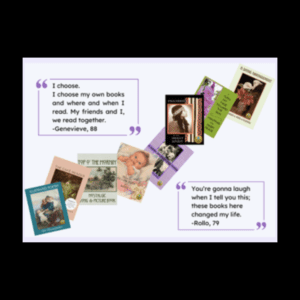
Reading alongside someone, on a topic they love, with images and words that reflect their inner world — is one of the strongest ways to make that happen. You don’t need to be a clinician. The healing often goes both ways. We soothe them, and in the process we learn, we grow, we soothe ourselves.
What Families Most Need to Hear
 What Families Most Need to Hear
The biggest misperception about reading aloud to someone who is no longer verbal, who is mostly sleeping, who seems to be slowly releasing their physical body, is that it doesn’t matter. That they can’t hear us. That we are wasting our time.
We are not.
When all of the adult children fly in from across the country and gather at a bedside, their loved one is at the edges of life and death, embodiment and something beyond it. The Celtic spiritual tradition has a name for this: a thin place — those sacred threshold moments where the boundary between the human and the holy grows gossamer thin. Julianne Stanz, in her beautiful book Braving the Thin Places, describes them as spaces where we are most open to grace, most fully alive to what matters. The bedside of a dying loved one is perhaps the thinnest place most of us will ever experience.
To sit in that space together is sacred. But to have nothing to bring — no prayer, no poem, no song, no story — can create a particular kind of tension. Hand-wringing silence in a space that is often surreal and confusing.
We can put beauty into that void. We can illuminate it. And that light shines back on us all.
This quality stood out to me in Paul Harding’s 2009 Pulitzer Prize-winning novel Tinkers, a short, luminous book about a man dying at home in New Hampshire, whose mind wanders back across time to his own father, an itinerant tinker grappling with epilepsy, mending pots and repairing clocks to support his family. In that wandering, in those supernatural visions at the threshold, everything becomes clarified. The mundane and the transcendent collapse into one another.
When we read alongside one another — when we bring resonant words, images, and presence into that room — we honor the spirit within all present.
Nothing Replaces a Human Voice
 Nothing Replaces a Human Voice
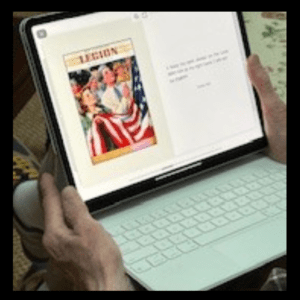
With technology on the rise in eldercare, people ask: does it matter whether it’s a person or a bot? Can virtual visits or AI companions stand in for real presence?
No. They cannot. AI is useful for curating content, gathering information, handling logistics; I’m not dismissing that. But leaving someone alone with only delivered meals and an AI companion would be bleak and wrong. We are more than bodies to be fed, medicated, and scheduled. We are complex souls with layered histories, tastes, and sensibilities that no machine, no matter how clever, can truly tune into. Togetherness, real, human togetherness, is why we are alive.
The Gift of Congruence
A dear friend who has worked in therapeutic riding for sixty years always says people are most congruent when they’re crying. Their insides match their outsides. The happiest people, at any age, are the most congruent, and at the end, especially, we seek common threads and that sense of wholeness.
A quiet gift of cognitive change, when the usual filters start to slip, is that people become more fully themselves. The unvarnished self comes forward. If we create safe space for that through reading aloud, through shared poetry, prayer, and stories, through the closeness of two people reading together, we give each other the gift of a lifetime: to love and be loved, exactly as we are. Sometimes in spite of the flaws. Sometimes because of them.
We Look Into the Light
Whether you’re a family care partner, a hospice volunteer, a library professional, a member of a faith community, or just someone sitting at a bedside unsure what to say, you already have everything you need.
Your voice. Your presence. A good book. A poem. A hymn. A funny story from 1881 about a disastrous date.
To close, here’s the poem that brought tears of laughter to that quiet man’s face at the Oddfellows Home. It’s a classic piece of Vaudevillian humor by Billy Mortimer — perfect for sparking a laugh.
I Had But Fifty Cents
 I Had But Fifty Cents
I took my girl to a fancy ball;
It was a social hop;
We waited till the folks got out,
And the music it did stop.
Then to a restaurant we went,
The best one on the street;
She said she wasn’t hungry,
But this is what she eat:
A dozen raw, a plate of slaw,
A chicken and a roast,
Some applesass and sparagass,
And soft-shell crabs on toast…
Read the poem’s full text here →
I Had But Fifty Cents (Billy Mortimer, 1881)
http://kristinhall.org/songbook/OldChestnuts/IHadButFiftyCents.html)
For Further Reading
– Emotional Agility by Susan David, Ph.D. (Avery, 2016)
– Tinkers by Paul Harding (Bellevue Literary Press, 2009)
– Contented Dementia by Oliver James (Vermilion, 2008)
– Braving the Thin Places by Julianne Stanz (Ave Maria Press, 2021)
Submitted by Laurette Klier, M.ED. , CDP, CSA, iCST
Laurette Klier is the founder of NostalgiaWorks (NANA’S BOOKS) and co-founder of Mindful Libraries. She creates identity-affirming reading materials for people with dementia in memory care, hospice, and libraries nationwide. A six-time national award winner for innovation in person-centered care.
Learn more at Nostalgia Works and Mindful Libraries