
Your Loved One Keeps Calling: The Truth About Why Repetitive Dementia Phone Calls
 Submitted by Kirstin Thomas,
Co-founder of KindredMind
When a person living with dementia calls looking for you, the content of the question is almost never the point. “When are you coming?” is not a request for a time. “Is dinner ready?” is not a question about food. These are expressions of anxiety, of disorientation, of fear, of an overwhelming need for reassurance from the person who represents safety.
My mom has called me sometimes ten times before lunch. The same question, over and over. When am I coming? Is everything okay? What time is it? And every time I answer, she sounds relieved, genuinely, completely relieved. Within minutes, she calls again.
For a long time, I thought I was doing something wrong. Maybe if I gave a better answer, she would feel more settled. Maybe if I explained more clearly, she would remember. It took me a lot of research to understand what was actually happening and why the call was never really about the question.
If your loved one keeps calling you over and over, this article is for you. Not to tell you how to stop the calls. But to explain what the calls actually mean, why they happen, and what actually helps, both for the person living with dementia, and for you.
The Question Is Never Really About the Question
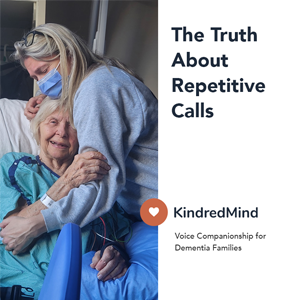 When a person living with dementia calls looking for you, the content of the question is almost never the point. “When are you coming?” is not a request for a time. “Is dinner ready?” is not a question about food. These are expressions of anxiety, of disorientation, of fear, of an overwhelming need for reassurance from the person who represents safety.
This pattern has a clinical name: separation anxiety in dementia. It is well documented in dementia care research and is one of the most common and exhausting challenges family caregivers face. UCLA Health’s Dementia Care Program describes it precisely: people with dementia forget they called before or asked the same questions even five minutes ago. The reassurance works in the moment but cannot be retained. The anxiety resets. The call comes again.
This is not intentional. It is not manipulative. It is not a sign that your loved one doesn’t trust you or that they are getting worse faster than expected. It is a direct symptom of how dementia affects memory, specifically the inability to hold onto short-term information. Your loved one is not choosing to forget that they just called. The brain simply cannot make that memory stick.
Understanding this does not make the calls easier to manage. But it changes what we are trying to solve for. We are not trying to stop a behavior. We are trying to meet a need.
What Most Caregivers Try and What Actually Happens
Every family navigating repetitive dementia phone calls eventually tries the same set of approaches. Most of them make sense in the moment. Most of them do not solve the underlying problem.
Answering every call gives your loved one the reassurance they need in the moment, but it is not sustainable. The anxiety resets, the call comes again, and caregivers quickly reach a point of exhaustion that makes everything harder.
Not answering reduces the interruptions but leaves the anxiety unresolved. The person living with dementia calls again and again, becoming more distressed with each unanswered attempt. Many caregivers describe the guilt of seeing the missed calls accumulate as one of the heaviest parts of the experience.
Blocking calls or limiting phone access removes the symptom but not the cause. The anxiety that was driving the calls does not go away when the phone is unavailable. It finds another outlet, often a more distressing one. The Alzheimer’s Association describes the phone as a lifeline. Removing it takes away not just the calls, but the connection.
Scheduled call times work for some families in early stages, when the person living with dementia can still use a calendar or clock to orient themselves. As dementia progresses, the concept of “I will call you at 2pm” becomes increasingly difficult to hold onto. The anxiety does not wait for the scheduled time.
None of these approaches are wrong. They are all understandable responses to an exhausting situation. But they share a common limitation: they manage the call from the caregiver’s side rather than addressing the need on the caller’s side.
What the Research Says About What Actually Helps
 Decades of dementia care research point consistently toward one conclusion: when a person living with dementia is experiencing separation anxiety, the most effective response is to meet the emotional need, not to manage the behavior.
Validation therapy, developed by dementia care specialist Naomi Feil and refined over decades of clinical use, holds that the emotional reality of a person with dementia is valid, even when the factual content of what they are saying is not. When your loved one calls asking when you are coming home, they are not wrong to feel anxious. They are not wrong to want the reassurance of your voice. The appropriate response, according to validation therapy principles, is to acknowledge the emotion first, to hear the fear behind the question, before offering any information.
This is also the foundation of simulated presence therapy, a clinical approach that uses recordings of a familiar family voice to provide reassurance and reduce distress in dementia care. A 2024 randomized controlled trial published in the International Journal of Neuroscience (PubMed ID 38646703) demonstrated meaningful reductions in agitation, anxiety, and caregiver burnout when familiar voice presence was combined with standard dementia care. The research is clear: what the person living with dementia needs is not information. It is connection, and specifically, connection through the voice of the person they love and trust most.
The Alzheimer Society of Canada’s published guidelines for dementia-friendly phone calls reinforce this approach: respond warmly, give one piece of information at a time, allow generous processing time, and interpret every word charitably. These guidelines describe the same principle that should guide any response to a person living with dementia. Meet the emotional need first, and let the factual content follow.
The Caregiver Side of the Call
There is a part of this conversation that does not get talked about enough: what happens to the caregiver.
Repetitive dementia phone calls are not just exhausting in the moment. They accumulate. They interrupt sleep, work, meals, parenting, and the small moments of ordinary life that make everything else sustainable. Many caregivers describe reaching a point where they flinch when they see an incoming call from their loved one, not because they don’t care, but because they are depleted.
And then there is the guilt. The guilt of not answering. The guilt of answering with impatience. The guilt of blocking the number just to get through a meeting, and spending the rest of the day thinking about it. Dementia caregiver guilt from missed calls is one of the most common and least discussed aspects of caregiving for someone with dementia. It is also, in most families, completely unaddressed.
The most important thing I want you to take from this article is this: you are not a bad caregiver because you cannot answer every call. You are a person with a life, with other people who need you, with a body and a mind that require rest. The goal is not to answer every call yourself. The goal is to make sure your loved one is heard, that their anxiety is met with warmth and presence, and that you have the capacity to keep showing up over the long term.
Those two things are not in conflict. They are the same thing.
Why I Built KindredMind
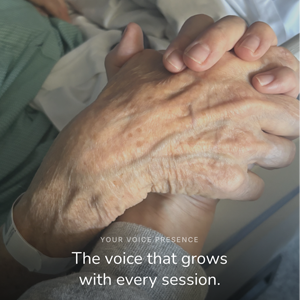 My mother Sharon lives with frontotemporal dementia in a memory care facility in Ontario. I am her only child. I hold legal decision-making authority for her care. I visit her almost every day. And she still calls me, sometimes ten times before lunch, because what she needs is not help with a task. She needs to hear my voice telling her everything is going to be okay.
I could not always answer. And every time I couldn’t, Sharon’s anxiety was left unresolved, and I carried the guilt of that for the rest of the day.
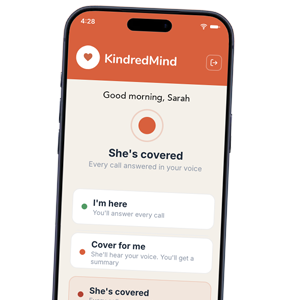
I searched for something that could help, something that would answer Sharon’s calls with my voice, meet her emotional need with warmth and patience, and let me be fully present in my own life while knowing she was being heard. I could not find it. So I built it. KindredMind is a Canadian-based voice companion for dementia families that answers calls from loved ones living with dementia in the family caregiver’s own cloned voice, calm, familiar, and present. It is built entirely on the clinical frameworks described in this article: validation therapy, simulated presence therapy, and the Alzheimer Society of Canada’s communication guidelines for dementia care.
KindredMind does not replace the caregiver. It amplifies them so they can be there for everyone who needs them, including themselves.
What You Can Do Today
If you are managing repetitive dementia phone calls right now, here are the most evidence-based things you can do:
- Reframe the call. When you see your loved one calling, try to hear it as: “I am scared and I need the person I love most.” That is what the call is. It changes how you answer.
- Lead with the emotion. When you answer, before you give any information, acknowledge the feeling. “I know you have been thinking about me.” “It sounds like you were worried.” This is validation therapy in practice, and it works.
- Give one piece of information at a time. Complex answers are hard for someone with dementia to process. Keep it simple, warm, and clear.
- Let go of the idea that the right answer will stop the calls. It will not, because the calls are not really about the answer. They are about the connection. Once you stop trying to say the thing that will make them stop calling, you can focus on making each call feel like enough.
- Find a solution that answers when you cannot. Whether that is a trusted family member, a care worker, or a tool like KindredMind, the goal is to make sure your loved one’s calls are answered with warmth even when you are not available. Your loved one needs to be heard. You need to be sustainable. Those two needs deserve equal weight.
The Call Matters. So Do You.
Repetitive dementia phone calls are one of the hardest parts of loving someone with dementia. They do not reflect a failure of care, a worsening of the disease, or a lack of love on either side. They reflect something profound: your loved one trusts you with their fear. You are the voice they reach for.
That matters enormously. And so does the fact that you cannot do this alone, without support, indefinitely. Finding ways to make sure your loved one is heard, even when you cannot be the one to answer, is not a compromise. It is what sustainable caregiving looks like.
Submitted by Kirstin Thomas,
Co-founder of KindredMind
Kirstin Thomas is the co-founder of KindredMind and a dementia family caregiver. Her mother Sharon, lives with frontotemporal dementia in a memory care facility in Ontario. Kirstin built KindredMind from lived caregiving experience to address one of the most exhausting challenges in Alzheimer’s and dementia caregiving: repetitive distress calls and the guilt and burnout that follow. KindredMind is a Canadian-based AI voice companion for dementia families, grounded in simulated presence therapy and Alzheimer Society of Canada communication guidelines.