
When the Tablet Stops Working: No-Touch Engagement for Residents With Advanced Dementia
 Submitted by:
The team at EyeClick, creators of Obie, a no-touch interactive projection system designed for senior living and memory care. Obie brings gentle, full-body engagement to residents of all abilities, with no wearables, touchscreens, or devices to hold. EyeClick has spent more than 20 years building interactive experiences that meet people where they are.
Obie by EyeClick
There is a quiet moment that plays out in a lot of memory care communities that Obie of Eyeclick is addressing.
#MemoryCare #DementiaCare #ResidentEngagement
There is a quiet moment that plays out in a lot of memory care communities.
A resident who once loved scrolling through family photos on a tablet, or tapping along to a game, slowly stops reaching for it.
The screen that used to light them up now sits untouched. Staff try to help, guiding a finger to the right spot, but it leads to confusion, then frustration, and the device gets put away. The resident withdraws a little more.
As dementia advances, the tools that worked earlier often stop reaching the person. Understanding why can open the door to engagement that lasts much longer into the journey.
Why touchscreens fall short in later-stage dementia
Touchscreens ask for a surprising amount.
A person has to understand that a small picture stands for an action, locate a precise target, and produce a controlled, accurate tap, all while filtering out everything else on the screen. In advanced dementia, fine motor control, visual processing, and the ability to follow a sequence of steps fade. The result is not a lack of interest. It is a mismatch between what the technology demands and what the person can still do.
The encouraging part is that other abilities are far more durable.
Long after someone struggles to tap an icon, they can still sweep an arm, reach toward color and light, sway to music, and respond to a friendly face. Engagement that meets the body where it still is, rather than the fingertip, tends to reach people much later in the disease.
 What no-touch engagement looks like
 What no-touch engagement looks like
“No-touch” simply means the activity responds to natural movement and presence, with no device to hold, no buttons, and no right or wrong way to take part. A few approaches that work well in memory care:
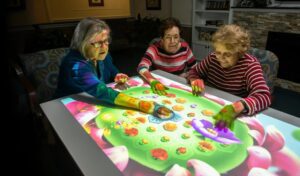
Responsive light and projection. Motion-activated projection turns a tabletop or section of floor into a scene that reacts to movement. A resident sweeps a hand and flowers bloom, leaves scatter, or koi swim away. There is nothing to learn and nothing to get wrong, which removes the frustration that often comes with screens. Interactive projection systems built for seniors, such as EyeClick’s Obie, are designed around this idea, but the principle matters more than any one product: the content should come to the resident, not the other way around.
Music paired with gentle movement.
Familiar music reaches parts of memory that words cannot, and pairing it with simple, invited movement, reaching, tapping a rhythm, swaying, adds a physical and social layer that lifts mood and eases restlessness.
Multisensory reminiscence.
Warm visuals, soft sound, and familiar themes, a garden, the seaside, a favorite season, give residents something to respond to with a glance, a smile, or a reaching hand, no instructions required.
How to choose engagement that travels with the resident
When you are evaluating activities or technology for a memory care setting, a few questions help you find tools that keep working as residents change:
– Does it respond to natural movement, with nothing to hold or wear?
– Can a couple of residents take part together, side by side, rather than one person alone with a screen?
– Is it failure-free, with no wrong moves and no scores?
– Does it offer a calmer setting for harder times of day, like late afternoon and sundowning?
– Can a staff member start it in seconds, with no technical setup?
Tools that pass these tests tend to include, rather than exclude, the residents who are hardest to reach.
The moments that matter
The point of all of this is not the technology. It is the moment a resident who could not tap an icon reaches into a field of projected flowers and smiles, or a small group at a table laughs together for the first time in a while. These moments protect dignity. They say, clearly, that there is still a way to take part, no matter how far along the journey a person is.
If a resident has stopped reaching for the tablet, it may not be the end of engagement. It may simply be a sign that it is time to meet them somewhere new, where movement, light, and connection do the work that buttons no longer can.
Obie by EyeClick
This article was contributed by the team at EyeClick, creators of Obie, a no-touch interactive projection system designed for senior living and memory care. Obie brings gentle, full-body engagement to residents of all abilities, with no wearables, touchscreens, or devices to hold. EyeClick has spent more than 20 years building interactive experiences that meet people where they are.