
After a Dementia Diagnosis, “Wait and See” Isn’t Your Only Option
 Submitted by:
By Daniel Kelly, NewDays Cofounder and Chief Innovations Officer
Daniel Kelly has spent his career at the intersection of technology and human health. He has also watched dementia move through multiple generations of his own family. He built NewDays because he knows firsthand what families face when the system offers nothing.
NewDays is a proven, research-backed treatment approach that combines clinically validated methods into one structured program. Through their clinical trials, patients have shown delayed symptom progression of 6 months to 2.5 years within 6–9 months of treatment.
Assumptions that there is not a lot that can be done are devastating to families
When a dementia diagnosis is delivered, the conversation often ends the same way: eat well, stay social, exercise when you can, and prepare for what’s coming. Families leave those appointments with heavy hearts and a quiet, devastating assumption that there is not a lot that can be done.
Andrea Pidgeon knows that feeling. Her mother was diagnosed with dementia a year ago. “My kids would say, ‘It feels like Grandma isn’t really there,'” she says.
That assumption – that there is little to do but wait – is wrong. And it’s costing people time they don’t have to lose.
 What you can do right now
 What you can do right now
There are real, evidence-supported steps families can take to support cognitive health after a dementia diagnosis. A few well-established ones worth knowing:
-
Physical exercise:
- Regular aerobic activity has been shown to support brain health and slow cognitive decline
-
Sleep:
- Poor sleep accelerates cognitive deterioration; prioritizing quality sleep is one of the most underrated interventions available
-
Social engagement:
- Meaningful conversation and connection are not just good for the spirit; they are good for the brain
-
Diet:
- Mediterranean and MIND diet patterns are associated with slower cognitive decline
These matter. But they are foundations, not treatments. And for most families, “eat better and stay active” doesn’t feel like enough, because it isn’t.
There’s a clinical treatment most doctors don’t know to mention
 There’s a clinical treatment most doctors don’t know to mention
For decades, researchers have studied a category of interventions called cognitive rehabilitation. Think of it as physical therapy for the brain. Just as a person recovering from a hip replacement works with a physical therapist to rebuild strength and function, a person living with dementia can work with a trained neuropsychologist to set meaningful cognitive goals and develop strategies to achieve them.
The research behind this is substantial: over 300 randomized clinical trials. Cognitive rehabilitation and related interventions have been endorsed by the World Health Organization, the Alzheimer’s Association, and the American Academy of Neurology. In one landmark trial of 475 patients with mild to moderate dementia, participants who received cognitive rehabilitation reported improvements in their ability to complete personally meaningful daily tasks, and those gains held for at least nine months. Caregivers observed the same changes independently.
This isn’t experimental. It’s proven. It’s just not what most doctors have been trained to offer.
So why hasn’t anyone heard of it?
 So why hasn’t anyone heard of it?
The honest answer is a combination of awareness and access. Non-pharmacological treatments like cognitive rehabilitation aren’t taught in medical school. Many physicians genuinely don’t know how to recommend them. And even when a specialist does, the treatment requires trained clinicians, frequent sessions, and a level of individualization that makes it logistically and financially out of reach for most families. Until recently, it existed almost exclusively in research hospitals and academic medical centers.
That’s why we built NewDays
NewDays was founded to close that gap. Our program pairs biweekly telehealth appointments with a licensed cognitive specialist with daily AI-guided brain exercises delivered by Sunny, our AI cognitive trainer. The two work together the same way clinician visits and physical therapy homework work together: the clinician sets the direction, adapts the plan, and supervises progress; the daily practice builds the habit and delivers the repetition that makes it effective. If the AI piece sounds unfamiliar, that’s understandable — but Sunny isn’t a gimmick or a replacement for human care. It’s simply how we solve the access problem: making a proven, clinician-designed intervention available every day, from home, at a scale that wasn’t possible before.
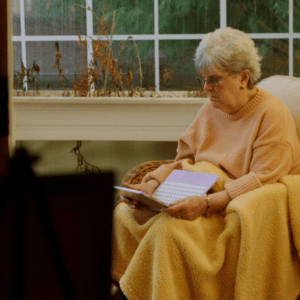 For Andrea Pidgeon’s mother, TJ, the change has been visible across the whole family. Andrea says she’s a “big stickler” for letting her mom do things herself rather than having others step in. And since TJ began working with NewDays, that independence has come back. “Now Grandma is back to being sassy again, more social, more engaged,” Andrea says. “It’s given me my mom back. I want her to live life to the fullest for as long as she can, and I believe this treatment has added years of quality to her life.”
That experience reflects what our outcomes data shows more broadly. In real-world results, peer-reviewed and presented at the AD/PD Alzheimer’s conference in 2026, 73% of NewDays patients showed measurable improvements in cognitive scores after 3 to 5 months of treatment. Patients living with dementia delayed symptom progression by over a year on average. Half of the patients saw meaningful reductions in depression; 75% saw reduced anxiety.
NewDays is covered by Medicare and available from home in Washington, California, Florida, New York, and Texas. No driving to appointments. No waitlists for specialists. The same clinically rigorous care that was previously out of reach.
You don’t have to wait
If your loved one has received a dementia diagnosis, or if you’re noticing early cognitive changes that concern you, you don’t have to sit with that uncertainty alone. There is something you can do today that is backed by evidence and supervised by experts.
Book a free consultation at newdays.ai — or call us at 206-801-1621, Monday through Friday, and speak with a real person.
Listen in to Lori chatting with Daniel on the Alzheimer’s Speaks Podcast.
Daniel Kelly, NewDays Cofounder and Chief Innovations Officer
Daniel Kelly has spent his career at the intersection of technology and human health. He has also watched dementia move through multiple generations of his own family. He built NewDays because he knows firsthand what families face when the system offers nothing.
NewDays is a proven, research-backed treatment approach that combines clinically validated methods into one structured program. Through their clinical trials, patients have shown delayed symptom progression of 6 months to 2.5 years within 6–9 months of treatment.