
Aging in Place: Part Two: Navigating Rehabilitation after Physical Injury
 Submitted By: Lori K. Yauch, M.A., CCC-SLP @
MeaningfulMemoryMaker.com
“It’s a long way up when you’re coming from nowhere. You gotta fight a little harder. You gotta push a little more. … When you think you just can’t take it, that’s when you’ll make it! It’s a long way up!’ (Barry Manilow, John L. Annesi, 1985)
The opening lyrics offer Maggie encouragement. It reminds her that an obstacle isn’t the end of her journey; it’s just a fork in the road.
The Fork in the Road
 In the previous article, your loved one (“Maggie”) struggled to adjust to life after her friends moved away. Their absence brought feelings of loss and depression, making an already challenging transition even harder. Now, Maggie’s journey takes another turn. During a period of weakness, she fell and injured her hip—adding a physical setback to the emotional challenges she was already facing. Recovery would mean more than healing an injury; it would also mean finding renewed confidence, connection, and support and learning when to try, when to rest, and when to accept help. Small steps could take on new meaning, and progress would require attention to both her physical needs and her emotional well-being.
Maggie’s journey to wellness begins in the hospital, where treatment for her hip injury and recovery planning converge. From there, the focus shifts to ongoing inpatient rehabilitation at a rehabilitation center. At each stage of her recuperation, Maggie and her care partners will receive education and support from care teams.
What Rehabilitation Looks Like
The Hospital Stay
 After surgery, Maggie may experience more frequent episodes of disorganized thinking (delirium) after anesthesia. To shorten its duration, staff and care partners should have eyeglasses, hearing aids, and dentures available and put them in place as soon as Maggie awakens. When she arrives in her room, consider having a favorite blanket to keep her warm, her favorite music playing, and familiar faces around her to help calm her fears.
Each day, gently remind her of where she is, why she is there, and what to expect next. Equally important is helping hospital staff get to know Maggie as a person. Sharing her likes, dislikes, and familiar routines gives her care team a starting point for providing comfort and personalized support.
Comfort and support can also include daily visits from familiar faces (family and friends) to ease any anxiety Maggie may feel in this new environment and promote participation in the initial phases of rehabilitation.
Allied health professionals (physical therapy, occupational therapy, and speech therapy) will evaluate her status, see her briefly (the typical length of stay in the hospital without medical complications is 3-5 days), and recommend further inpatient rehabilitation at a rehabilitation center or skilled nursing facility.
The Rehabilitation Center
 When choosing the center, consider:
- Location: close to family and friends to encourage visitation and ongoing support
- State Survey Results. These address the quality of all services provided, cleanliness, food service, nursing, and rehab services, and you can request them.
- Patient surveys and outcome data, which can be provided upon request, as well as comments, which are often found online.
Once the center is chosen and the hospital stay ends, care partners should prepare for the transition by gathering Maggie’s identification documents, collecting personal items, ensuring she has comfortable clothing and familiar belongings, and confirming transportation arrangements. To ensure these details are covered, consider using a simple transition checklist. Maggie’s list may include, but is not limited to:
- Identification documents (driver’s license or state ID, Medicare/insurance cards, living will, durable power of attorney)
- Copies of current medication lists
- Comfortable and appropriate clothing and shoes
- Personal care items (toiletries, bathrobe, hearing aids, eyeglasses, dentures)
- Comfort items (favorite blanket, family photos, music player, books)
- Contact information for family members and key support people.
Keeping lists is an easy way to track important documents, items, and questions, reduce stress, and guarantee nothing is overlooked.
Review the center’s policies, visiting hours, and therapy schedule so Maggie and her loved ones know what to expect. As you did in the hospital, share essential information about Maggie’s needs and preferences with the new care team to support a smooth transition to this next phase of her recovery.
Traveling The Road to Recovery
 Depending on the surgical type (hip revision or replacement), rehabilitation may be short-term (4 weeks) or longer (8-12 weeks), based on the physician and rehab team’s recommendation and Maggie’s progress. The rehab team (PT, OT, and Speech Therapy) will design treatment plans to meet Maggie’s needs and promote the best outcome.
At this stage, her care partners and friends will play a crucial role in helping Maggie participate in her program. During all visits, review her daily posted schedule together with the memory log provided by speech therapy, which should highlight her daily activities (including, but not limited to, tasks completed in each therapy session, what she ate at each meal, and a brief statement of progress). Offer encouragement and praise as she reaches milestones (such as steps taken and tasks completed).
Supporting Independence Requires Safety First
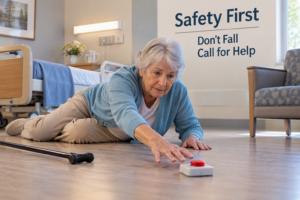 As treatment progresses, Maggie’s pain will decrease, and her mobility will improve; she may begin to assert independence (e.g., getting up independently to dress, use the bathroom, or assist a roommate). Encourage use of the call light to summon help. This prompt will support therapy goals to reduce injury risk. When you direct Maggie’s attention to the posted signs in the room (“Don’t Fall, Please Call”) and in the restroom (“Pull the Cord When Finished”), you are another link in the chain that will keep her safe in her new environment.
In consultation with therapy services, you may be asked to review hip precautions at each visit to promote safety and reduce the risk of re-injury. Reviewing these precautions and asking a few pointed questions will help Maggie maintain them.
- Don’t Bend Over
- Don’t Cross Your Legs
- Don’t Cross Your Ankles
Questions
- Should you bend over?
- Should you cross your legs?
- Should you cross your ankles?
- What should you do when you want to get up?
The first three questions require a “no” answer; the last requires a specific, structured response, such as “push the button for help,” and can be part of a treatment protocol called spaced retrieval. If this technique is appropriate for Maggie, the speech-language pathologist will discuss how to carry it over with her care partners.
Learning to move safely and establishing new routines are only part of Maggie’s recovery. Staying hopeful through the daily effort of rehabilitation can be just as challenging.
When You Think You Can’t Take It
 From the rehab professional’s perspective, Maggie’s program is progressing well. She is meeting goals, experiencing less pain, and working toward independence. However, as days turn into weeks and weeks into months, Maggie becomes frustrated because, despite doing well, staff tell her she is not ready to transition home. Her remaining goals include walking a distance, independent transfers, and increased use of her memory book to improve carryover of strategies.
She has shared her feelings with her family and friends, who now help lift her spirits. Watch for signs of discouragement or depression that can arise during recovery, such as withdrawal from activities, changes in sleep or appetite, persistent sadness or irritability, lack of motivation, or expressions of hopelessness about progress. Recognizing these signs early helps care partners provide extra support. If these feelings persist, worsen, or include serious concerns such as talk about self-harm, contact Maggie’s doctor or another healthcare provider right away. Don’t hesitate to seek professional help when emotional or behavioral changes seem beyond what is expected, or if you feel uncertain about what to do next. You can lift Maggie’s spirits by praising her accomplishments and encouraging her to do more each day. Don’t forget to bring her favorite foods, flowers, treats, and music. In the evening, bring the portable DVD player and sing along to her favorite classic movie musical. Finally, post a calendar counting down the days until she goes home.
That’s When You’ll Make It!
The calendar days are marked off. Progress has been made, goals have been met, and spirits are lifted as Maggie reaches the next step in her recovery—going home to her community of friends! Her care partners’ support will remain essential as she takes this next step. In the next article, Maggie will continue her recovery in her community through home care and outpatient services.

Submitted By: Lori K. Yauch, M.A., CCC-SLP @
MeaningfulMemoryMaker.com